Monday, June 8, 2020

Covid 19 Projections for India

Based on my earlier blog, I had developed a projection for Covid 19 progress in India. There have been four presentations so far on 24.05.20 with updates on 8.06.20 21.06.20 and 6.07.20

Links to the slides are given below. I would welcome your views.

https://www.slideshare.net/divyaroop/covid-19-stats-in-india-240520

https://www.slideshare.net/divyaroop/covid-19-stats-in-india-update-1-80620

https://www.slideshare.net/divyaroop/covid-19-stats-in-india-update-2-210620

The latest update was presented on 6.07.20. Key Highlights were:

Directions
• The last two weeks have seen  a general flattening of the death curve. The worst affected state, Maharashtra, continues to adjust previous period deaths leading to some softness in the figures. Hopefully, we will not see another anomaly.
• The return of migrant workers to their home states have still not led to a spurt in deaths in UP and Bihar though the trends are going up.

• Increased testing is leading to a larger discovery of cases. However as discussed earlier this has little bearing on the progression of the pandemic.

• Based on current trends, we can expect a decline in deaths per day to start around the 15 – 20th of July when the cumulative deaths stand at  22,000 – 23,000. The date is in line with our initial estimates, but the death toll is significantly less. The major risk is that the rural hinterland will see an explosion of cases after some time. This view has been expressed by Dr Ashish Jha of Harvard.

Thank You!

Please mail me at debubhatnagar@gmail.com with any comments or questions

The link to the slides is given below:

https://www.slideshare.net/divyaroop/covid-19-stats-in-india-update-3-60720

Tuesday, May 19, 2020

By when will Covid 19 start declining in India?

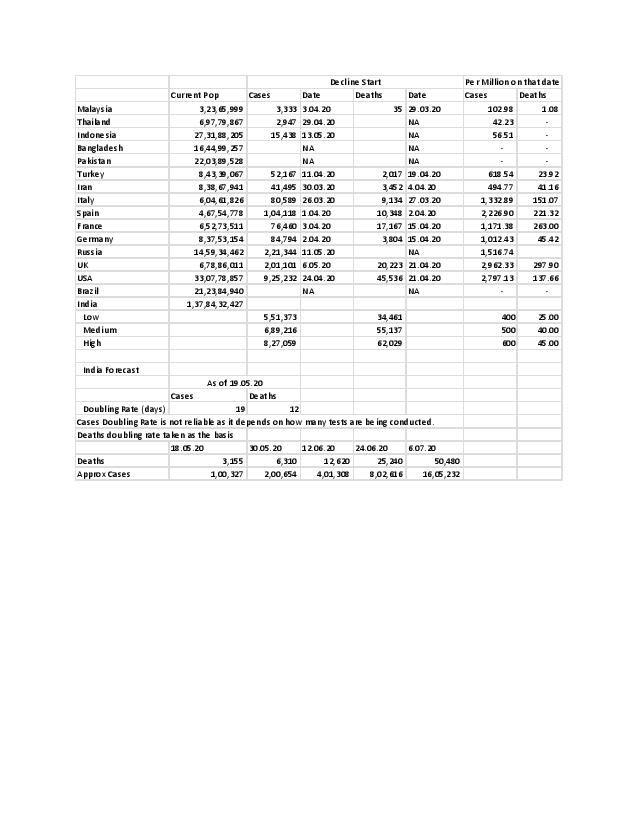
Like many of us, I have also been keenly following the numbers on the Covid 19 Pandemic. Since we live here, the focus is more on India and what is going to happen. I had developed a model to forecast by when we would start seeing a decline in deaths in India that I shared with family and friends.

Rather reluctantly, on their urging, I am sharing the findings on my blog. Please note that this is strictly an amateur's work. If the predictions don't pan out, well it will be no worse than some of the astrologers who are now running for cover!

Here goes:
  1. Here is where I stick my neck out. I have done an international per capita model of cases and deaths and used it to forecast what will happen in India
  2. Broadly there are 3 types of countries and progression of Covid 19. Asia including Turkey and Iran where the disease progressed more rapidly and counties like Malaysia and Thailand which have hardly been touched at all.
  3. Europe and North America which are broadly similar
  4. Brazil is still to stabilize
  5. I have taken the dates on which a decline started of cases and deaths for each country and worked out the per capita cases and deaths on that day
  6. This analysis results in the conclusion that India is likely to behave like West Asia -  tropical counties of Malaysia, Indonesia and Thailand will do better than India.
  7. Deaths are more reliable than cases as a measure for forecasting as cases are dependent on how much testing is going on
  8. Based on the above analysis, my prediction is that India deaths/day will start declining around 1 July to 10 July. The number of deaths in India (based on a 7 day moving average are doubling in 12 days) will reach the projected number of 35,000 - 62,000  after which they should start declining as per the model.
  9. The decline will start earlier in places like Ahmedabad, Pune and Mumbai where the spread is already greater. However, as a whole the country will start seeing the decline on the dates stated above.
  10. This model assumes that the per capita infections and deaths when they reach a certain level in the population the infection progress recedes. It must be something similar to herd immunity but the pundits are reluctant to use that word
  11. The more you ease off from the lockdown, the quicker we will reach the tipping point. The doubling rate will become quicker.
It would be great to hear your reactions on this post.

Regards and stay safe.


Sunday, May 3, 2020

We Deserve our Slums

Indians are masters at avoiding uncomfortable truths.

Are we racist? Yes - if only you would stop to hear the racial slurs that we cast on Blacks or even our own people with darker skins. How many dusky little girls have been taunted by the ditty "Kali kaluti, baingan luti. Bhare bazaar mein dham dham kuti." Are we elitist? Yes - in our condominium block in Gurgaon  there was a vigorous debate on whether maids and drivers should be allowed to use passenger lifts - there are only two lifts, one for 'passengers' with the other one being labelled 'service lift' Are we casteist - Social distancing was just made for us. Untouchability still thrives in rural areas, however much we may like to deny it. And finally are we anti Muslim? The biggest elephant in the room today.

This blog post is not intended to recite a litany of the ills that beset Indian society. Rather, I will focus on only one that is perhaps derived from some or all of the above.

Simply put, we are a mean people. We drive past Dharavi in our air conditioned cars and turn up our noses at the whiff of fecal matter that manages to make it past the filtration system. Why doesn't the administration clear these slums for heaven's sake? Why do we pay taxes? The govt just does not do anything!

The uncomfortable truth is really very simple. If we are only willing to pay a plumber Rs 800 per day or even less in the smaller towns, he will earn around Rs 16,000 or so per month. So will a driver or a blue collar worker in a factory. On that, he has to rent a little kholi, commute, eat, provide for clothes and education for his family and hope that he does not fall ill as if he does he is not likely to able to afford decent medical care. Perhaps the family may earn a little more if his wife works in one or more of our households as a maid. Our 'low costs of labour' are like a millstone round our necks. They condemn our working classes to a life of penury amidst filth, disease and no prospects of growth. Can we seriously question why we have slums? They are the places where we condemn those who work for us to live.

We deserve our slums.


Read my nostalgic collection of short stories set in Mussoorie in the 1960s. Amazon is delivering the Kindle Edition these days. Stay safe.  Click to buy


Friday, March 6, 2020

AAP - A Method in their Madness?

The AAP certainly seems to have gone through some kind of metamorphosis. Kejriwal reciting the Hanuman Chalisa, presenting flowers to a smiling PM and generally getting along with the current LG are all signs and symptoms of this change.

The graver charge that some of his supporters levy is that he has compromised on his moral principles. He did not come out in support of Shaheen Bagh, he appeared to be aligned with the BJP on the Delhi riots and generally seems to have discarded his activist credentials along with whatever sense of honour he may have had to start with.

To understand this a little better, one has to examine three issues:
  1. All in all, India seems to have shifted smartly to the right. It also seems to have become more overtly religious and attitudes have hardened one way or the other. In these fraught times, I feel that Kejriwal has deftly highlighted his own Hindu identity without compromising on his party's secularism.  It defangs the more vocal right wing and creates a sort of Hindu nationalist space for Kejriwal that allows him some room to operate. The originator of this strategy being Mahatma Gandhi himself. Rahul Gandhi in his own ham fisted way also visited temples but it was evidently hypocritical and actually hurt the Congress. Kejriwal seems to strike the right notes with his innocent Aam Aadmi look complete with school-boyish sweater and trousers, so one may actually believe him.
  2. The second issue is about focus. Kejriwal clearly won a resounding mandate in Delhi due to his track record of good governance. Evidently, the Delhi public sees him as an effective CM who delivers on his promises especially for the poorer segments of people. Do they want him to also be an activist who flaunts his beliefs about the CAA and other contentious matters? How does that help the Delhi voter? Not visiting Shaheen Bagh was clearly a good strategy. In fact the more contentious issues that Kejriwal picks up, the greater the possibility of conflict with the Central Government. Is this worth it? I think not. Let him be one of the few CMs who does what he was elected to do rather than fight random battles. 
  3. That brings me to my third point about picking the right battles to fight. Kejriwal and his govt have been accused of being conspicuous by their absence during the Delhi riots. It was perfectly clear  that the Delhi police's lackadaisical response initially had nothing to do with Kejriwal. He does not control them and can not influence them either. Equally, the sterling work done by the police afterwards had nothing to do with Kejriwal either. He is a sort of truncated CM. Best to remember that and do what you can at the appropriate time. The decision to allow Kanhaiya Kumar to be prosecuted is similar. Why should Kejriwal put himself in the unenviable position of stalling the prosecution of a potential anti national?Whatever his views may be on the subject and whether Kanhaiya is anti national or not, it's better to let the law take its course and not be seen as an obstructionist. Besides, how does this help with Delhi governance for which Kejriwal has been elected? Aa bail mujhe maar was always a loser's strategy. Fortunately Kejriwal seems to have outgrown this tendency.
Make up your minds, folks! Do you want an effective CM who delivers on his promises or do you want a bleeding heart liberal who gets mocked and tripped up at every turn? I think Rahul Gandhi is stepping firmly into the latter profile. More power to him.

I know that this post will cause many liberal folk to froth at the mouth at Kejriwal's perfidy. The cry of the AAP being a B team of the BJP is floating around in Delhi drawing rooms. But do consider that the ability to adapt to changing circumstances while retaining a sharp focus on your objectives is a desirable quality. As the AAP matures, it is heartening to see that Kejriwal is handling this transition with a deft touch. It augurs well for a possible second foray for AAP into politics outside Delhi. If he sheds some supporters along the way especially from the garrulous middle class fat cats so be it. They were never his core target segment.


Take a look at my book of nostalgic short stories set in Mussoorie.


The book has received 5 star reviews from around the world and has been featured in the Amazon hot new releases for travel writing. You can buy it by clicking the link Amazon

Saturday, August 17, 2019

Morality? A Rara Avis.

I am in the process of selling a flat in Gurgaon. As I told brokers and buyers that I wanted a 'full cheque' payment (My apologies to any foreign readers who may not understand what this means. What I am referring to is the Indian practice of taking part of the payment in cash, thereby avoiding tax) their expressions ranged from frank incredulity to pity. WHY would anyone want to pay a penny more tax than was absolutely necessary even if the process involves doing something blatantly illegal? Clearly, the process of defrauding the government was being blithely undertaken by all concerned, the government's tall claims of having reduced/eliminated 'black' money notwithstanding. It's a different matter that the colour of the 'black' money is now a bilious  pink, given the rather loathsome colour of the new Rs 2000 notes.

Recently, I needed to change the tyres on my car. The dealer offered me 3 alternatives for payment:
  1. Cash - no tax (GST) would be levied. On my asking what would happen to the warranty for the tyres as it would be an unrecorded purchase, the dealer reassured me. "Hum hain na sirji. Tusi nischint raho." Again, the flavour of this statement is typically North Indian. Full of nice sounding insincerity.  
  2. Cash or Cheque with GST. Here the cost was significantly higher due to the high rates that are applicable under the GST regime.
  3. Credit Card - Here an additional 2% would be levied on top of option 2 by the dealer to account for the credit card charges that he had to pay the card company. 
He was clearly disappointed and a bit contemptuous when I opted for 3. However I manged to mitigate my own stupidity by prevailing upon him to forgo the 2% credit card charge. A small victory indeed!

There are innumerable examples of the traffic police coming up with 'Good Driving Week' where they will challan you if your car crosses the stop line at a traffic light, or for over-speeding or a whole range of minor traffic offences. Once the week is over, it's business a usual with a quiet colloquy with the traffic cop and some money that solves all problems.

It is fair to say that there are some areas where such dishonesty has been reduced or eliminated. Railway reservations, driving licences, passports, etc, largely due to IT that has led to the elimination of touts and brokers. However, the Indian psyche seems to naturally gravitate towards the easy (and cheaper) way out.

So are we an immoral society? The short answer is "yes".

Politicians and Godmen never tire of extolling the virtues of our glorious past. We claim to have have invented virtually everything from aeroplanes to nuclear bombs and we have a monopoly on any intellectual or artistic activity. A truly prolific and talented people indeed! We can be justly proud of the Ramrajya in the past but spare a thought for our immoral present where 'subkuch chalta hai' and businessmen and others revel in the tax that they have evaded and the rules that they have bent!

I wonder when it became socially acceptable to entertain a black-marketer or tax evader in your drawing room. The only problem is that you may lose all your friends and acquaintances if you were to rigidly enforce this rule. Coming to think of it you may be barred entry into your own drawing room as well!

PS - I did finally manage to sell my flat on 'full cheque' payment. Looks like I'm not the only foolish fellow around!


Take a look at my book 'Journey to the Hills and other Stories'. This nostalgic collection of short stories has reached the Amazon bestseller list for travel writing and has been highly acclaimed by readers.


You can buy the book from Amazon. Just click on the Link

Wednesday, April 17, 2019

Colonial Hangover

There are many types of Colonial Hangovers that India suffers from. Many of us are closet anglophiles and have a sneaking admiration for the language and customs of an England, all but forgotten by the English themselves. Brexit is an example of a classic muddled English mess, not to be confused by the food they eat which is messy enough. Having said all this, one of the most pernicious colonial hangovers is our system of Government.

Parliamentary democracy originated in the 'Mother of all Parliaments' in Westminster and was probably appropriate for a small, rain soaked medieval island, struggling to free itself from capricious kings, an effete aristocracy and a dominating clergy. The necessity of an 'Upper House' where the offspring of dukes and earls could be accommodated was probably necessary if you had to maintain a semblance of a monarchy with the attendant trappings of an aristocracy. Why is it necessary in India? Here the Rajya Sabha is full of irrelevant nominees and it's only purpose seems to be to act as a check on the legitimately elected Lok Sabha. Why is such a check necessary? Carrying on the same theme, why must we have a ceremonial President who lives in a 350 room mansion and mimics the ceremonial duties and functions of the Queen of England? It seems totally absurd.

Even more absurd is the relationship between the States and the Centre. Our states are big places with populations of 100 Mn or more. Yet, in our legislation we have a Central list, a State List and hold your hat a Concurrent List of areas where the State, Centre or BOTH can create legislation. If this is not a mess what is? The pathetic situation in Delhi is a case in point where an elected Chief Minister who won by a record margin has to kow tow to a mid level bureaucrat. Surely the States should be competent to run their own affairs and we should not have situations like the GST where we have 3 types of GST to cater to the States and the Centre's wishes.

I could go on in this fashion. What we clearly need is a rethink on the way that Government works in our country. Specifically:

  1. What should be role of the States vs the Centre. As our Economy grows, each state has become a powerful economic entity. Socio-Cultural differences are stark between one State and another. Surely, they should be allowed to manage their own affairs with only a limited role for the Centre?
  2. What should be the Governance Structure? Roles and responsibilities need to be defined and the public should be clear about what they can expect from their elected representatives. Are any of us clear about what we should expect from our MPs or MLAs vs the bureaucracy? I for one am not clear at all. If political parties wish to claim that they are the ones who deliver economic prosperity in a physical sense to people as opposed to merely legislation let them define their roles and responsibilities clearly for the public.
  3. Delayering and role clarity are some of the mantras of modern management practice. Sadly the reverse seems to be the case in Government. Instead we have multiplicity of roles, lack of clarity of objectives and so forth.
  4. What is the role of the IAS? This is a generalist cadre who magically become MDs in highly technical enterprises. They also become Economists almost by osmosis and take on important roles in Finance. Many elected MPs and others complain of the stultifying attitude of the IAS. Surely we need to rethink the role of 'Collectors' - another Colonial Hangover.  
As of now I for one do not see any thinking or a way forward on any of these issues. Governments come and go but we do not see concrete and meaningful changes in the WAY we work. The net result is that there is very little difference between the performance of one Government and another. They may shout from the rooftops about their contribution and how they are different and better but deep down inside it's all much of a muchness.

India deserves better.


Take a look at my book 'Journey to the Hills and other Stories'. This nostalgic collection of short stories has reached the Amazon bestseller list for travel writing and has been highly acclaimed by readers.


You can buy the book from Amazon. Just click on the Link

Wednesday, January 16, 2019

Affirmative Action and School Education

The Wikipedia definition of Affirmative Action is really quite simple

(in the context of the allocation of resources or employment) the practice or policy of favouring individuals belonging to groups known to have been discriminated against previously; positive discrimination.

In India the practice of reservations (the Indian equivalent of affirmative action) in Government schools , colleges and jobs has been mired in controversy and bitterness for decades. The recent move to introduce reservations based on economic status in addition to caste based reservation has created a new dimension. In some ways this goes against the spirit of the original plan for the uplift of people who had suffered discrimination due to the caste system for centuries. On the other hand, it acknowledges the reality of poverty even amongst the upper castes.

In the early '70's when I was a student at IIT Kanpur, the institute started taking in a few scheduled caste candidates. These students had a severe handicap partly because the medium of instruction was English. They had to take remedial classes for a long time before they could comprehend what was going on in the classroom. In addition, since entry standards were relaxed for them their ability to cope with the curriculum was very poor. The IITs also suffered on account of a drop in brand image and perception as top quality institutions. In all respects, the idea of opening up premier institutes of learning to such practices hurts both the students that it tries to help as well as the institutes themselves.

In my view the practice of reservation as carried out in India since independence is a lazy government's easy way out.

If we are serious about creating a level playing field the starting point is to ensure that high quality school education is made available universally. After that, individual merit will take a young person to the best colleges where scholarships and tuition waivers can be made available to needy students. Thereafter jobs will need no reservations as all applicants will be evaluated on merit alone. Let us examine how we have performed as a nation in the critical area of school education.

India is a young country.
34% of the population is of school going age. This corresponds to over 400 Mn children (Census of India) who should have access to high quality education.  This includes about 288 Mn upto class 10 and the balance upto Class 12.

To service these huge numbers, India has an estimated 14,65,000 schools:

No of Schools in India (FICCI/E&Y Study)
Government  8,18,000
Local body/muncipal  3,09,000
Private aided  1,57,000
Private unaided  1,81,000
Total 14,65,000

As can be seen from the above table, the vast majority (76%) are Government run though they account for only 60% of the enrollment. Government run schools are therefore smaller than their private counterparts.

Clearly, the onus of school education in India lies squarely with the Government and this is where we have miserably failed as a nation. Anyone who has been to a Government school will know that infrastructure is pathetic, the curriculum and text books are outdated and full of errors and most importantly teachers are either absent or if they do come to school at all they spend the day in gossiping and drinking tea. As for the quality of teachers, the less said the better. In many ways the Government school system is a microcosm of the pathetic state of most Government run enterprises, be it the Railways, the healthcare system, the Public Sector, Air India or any of the myriad enterprises that the Government claims to run.

The tragedy is that while the rest of the shebang can carry on, poor school education saps the energy of the nation. Without it the country rests on a very weak foundation. In fact the much touted 'youth bulge' or 'demographic dividend' is fast becoming a liability rather than an asset.

What needs to be done? I have the following thoughts:
  1. We need to have a dynamic and dedicated Minister for School Education. A person like Atishi Marlena of the AAP has made a significant difference to Delhi schools. Similarly, if the country is to progress, we need a dedicated, relatively apolitical leader.
  2. In the '70s, the Government had handed over the distribution of Nirodh to 6 private companies. Hindustan Lever, ITC, Brooke Bond, Lipton, Tata Oil Mills and Union Carbide. The scheme was a huge success with vastly increased volumes of the contraceptive becoming available in the remotest areas of the country.  Similarly, I would recommend that the responsibility for running Government schools should be handed over to the private sector with a clear division of geographical territory. Instead on 6 companies there should be many more with smaller, more focused areas of operation.
  3. CSR budgets of  companies should be earmarked for school education in addition to government budgetary allocations that are already available.  
  4. School education in Government schools should be entirely free and universally available to all citizens. Private schools will coexist but the objective would be to make parents actually prefer a Government school education for their children as is the case currently in many parts of the developed world. 
What would be outcome of such a strategy? Clearly, such strategies take time to bear fruit. However, in 10 - 15 years years time if pursued diligently we should be able to remove the inequities in our school education system. This will, in time, obviate the need for reservations in colleges and Government jobs. As Shakespeare put it, that would be 'a consummation devoutly to be wished!'


Take a look at my book of nostalgic family stories set in Mussoorie


You can buy the book from Amazon Just click on the link.