Wednesday, January 25, 2023

Indraprastha to Pataliputra - A Bihar Travelogue

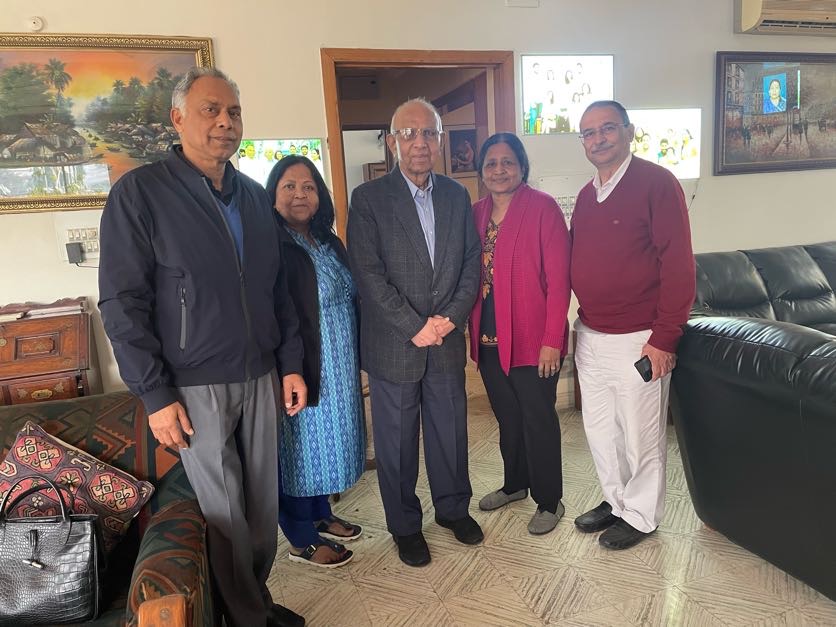
Our Samdhis (Dilip and Shrimi Sinha and Shrimi's father Dr HRP Varma) are from Patna and when they suggested that we join them there in January, we jumped at the opportunity. I hadn't visited Patna for years and anyway the last few trips time had been for work so there had been no time to visit any of the historical and cultural sites. I had a faint recollection of my Chachi's father's house in Danapur when I had visited as a child. So all in all, it was going to be a new experience. 

Day1

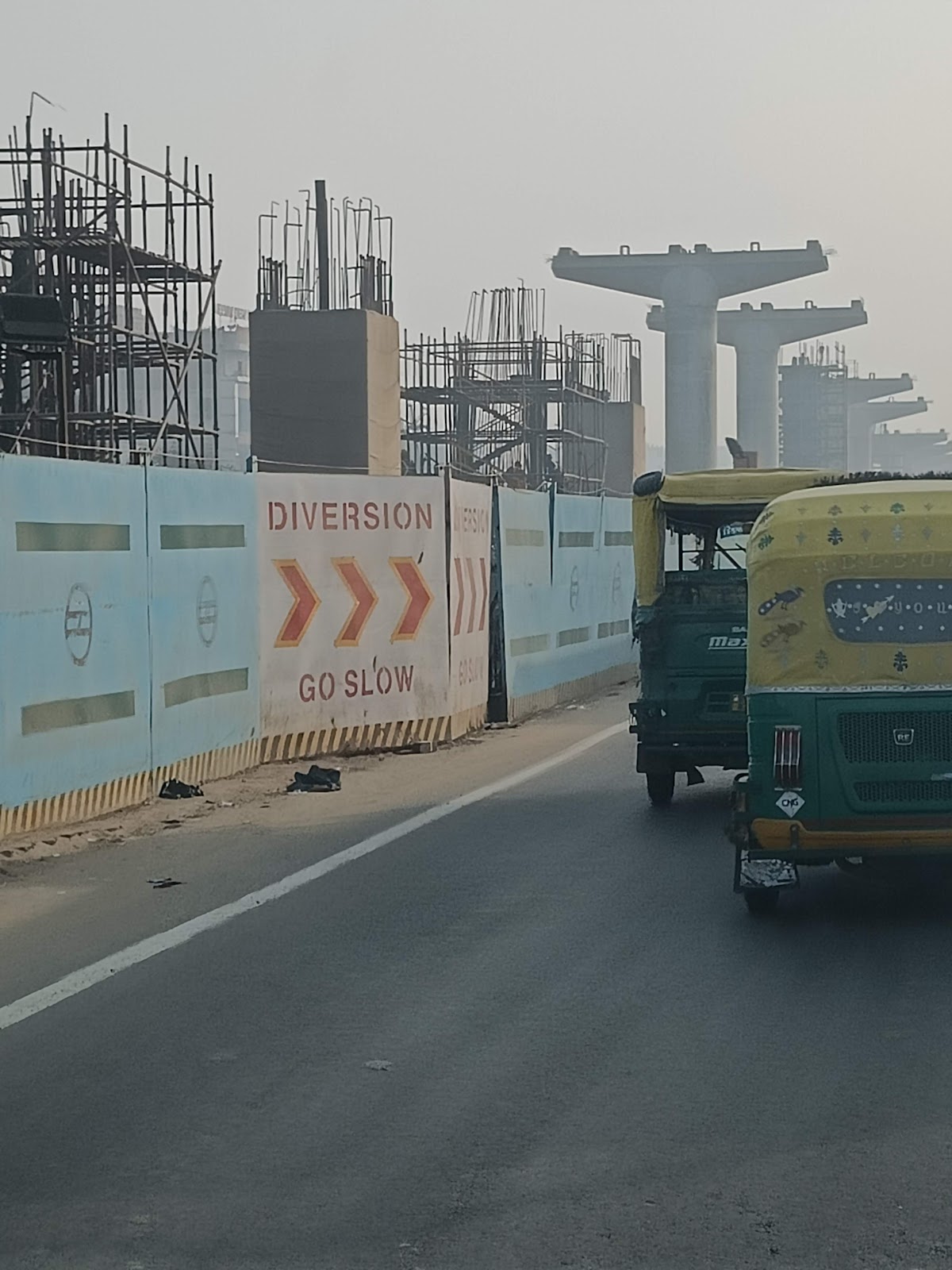
The flight to Patna was on Indigo. Landed on time at Patna. We had to walk to the terminal building which was a bit of a downer. There does seem to be a new terminal coming up but I heard that expansion in the current site is not going to be very easy. The airport could do with a facelift. However baggage arrived soon enough and we exited. The drive home was through some of the British built parts of Patna. The roads were good - broad and smooth and the buildings were impressive. It reminded me a little of Lucknow.  There is a metro under construction too.


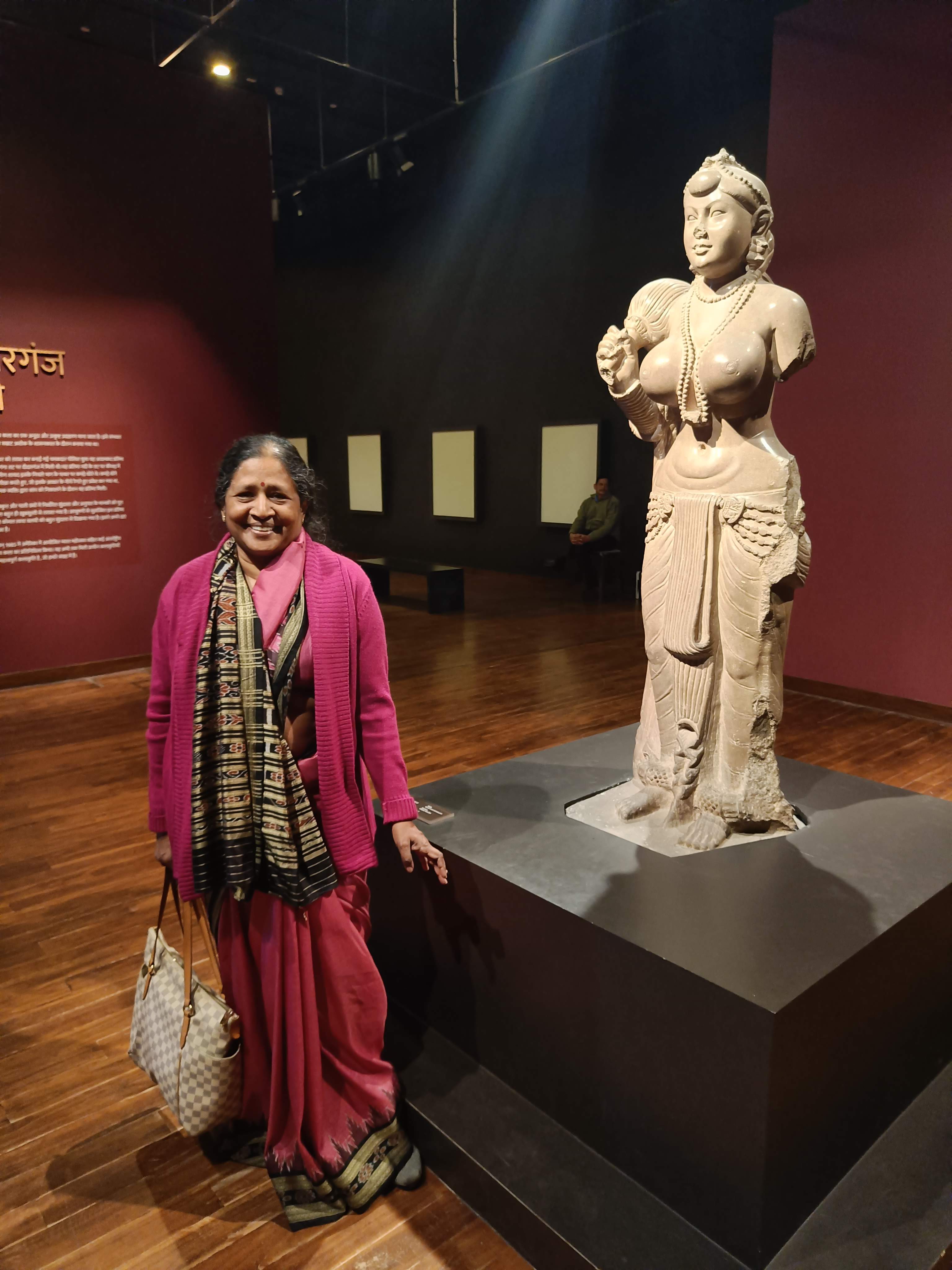
After lunch we set off to the  Bihar Museum. This is a very impressive new structure. It has been designed by a Japanese firm, and the building and the exhibits are world class. Since it is focused on Bihar, the exhibits take on a more immediate, local appeal. The growth and development of the dynasties, rulers and religious and spiritual leaders in Bihar is very well presented dating back to the Nandas and the Mauryas. The pride of place undoubtedly goes to the Didarganj Yakshi. This magnificent statue dates to Mauryan times and was being used as a Dhobi's stone till it was rescued!


After the museum visit, we had coffee and pakoras at the museum café - It's called Potbelly and is a part of the chain that has outlets in Gurgaon and Delhi. Their chutneys are interesting - one was made of Parwal that we had not tasted before.

After the museum visit, we went for a drive on Patna's Marine Drive. This is still being developed rather along the lines of Lucknow but as a famous courtesan in the 19th Century from Kanpur once said in defence of her hometown, 'Aakhir Gomti ko Ganga bana nahin sakte!' The sheer grandeur of the Ganga at Patna has to be experienced. It is hard to see the far bank and the two bridges spanning the river on either side of the city appear almost endless. They are each around 6 Km long. 

Day 2

The next day, we set off for Bodh Gaya. This is a 4 hour drive through the lush agricultural landscape of South Bihar. The boundary between South and North being the river Ganga. 


We skirted the town of Gaya set on the banks of the Falgu river and went straight to the place where Gautam Buddha had attained enlightenment. The Bodhi Temple and the Bodhi Tree under which He had meditated was clean and well kept. We had to get off on the outskirts of the town and take an electric auto (called TOTO in Bihar) to the temple. The Dalai Lama was visiting so there were more traffic restrictions than usual. The temple was full of pilgrims, mostly Tibetans settled in India but there were many from various South East Asian countries as well. There was Tibetan chanting going on and most of the pilgrims were following the text in their own books. We had a darshan of the Buddha at the Bodhi Temple but we were not allowed to take pictures. I wish the authorities would reconsider this restriction as for many of us these visits are precious and a photograph would be a great way of remembering it. 

Bodh Gaya has many impressive monasteries built by Buddhist countries like Japan, Thailand and Sri Lanka. It also has a beautiful 80 ft tall statue of the Buddha. 


The Govt has made efforts to develop Bodh Gaya. There is a large, modern convention centre and an international airport. However given the significance of the place in the Buddhist world a lot more can be done.
                                     

After Bodh Gaya we drove to Rajgir to spend the night. This is about 2.5 hrs. We stayed at the Kripanidhi Hotel. This has been set up by a Jain foundation so there is no alcohol (all of Bihar is dry) and strictly Jain food. That said, the food was delicious. In fact we called the chef to explain how a particular dish had been made and he told us that the gravy comprised of ground cashews and melon seeds! There is life beyond butter chicken! The rooms are elegant and so are the bathrooms. This is great choice for staying in Rajgir.


After breakfast we set off to the Vishwa Shanti Stupa in Rajgir. This is atop a hill. We took a ropeway to go up. The stupa is pristine white with gold images of Buddha on 4 sides. There's a Japanese Buddhist temple nearby where a man was beating a large drum. The place was calming and meditative. This is not an ancient stupa though but was set up fairly recently.


After that we went by an electric 'toto' through a forest to the oddly named Ghoda Katora. There's a calm lake in a valley with a Buddha statue in the middle. The place looked untouched and quiet. We didn't go for the safari due to shortage of time but this looked like a very exciting place for children to visit.


Our last visit in Rajgir was the museum dedicated to Huen Tsang (Xuanzang), the Chinese traveler who visited India and spent time in various parts of Bihar in the 7th Century. The museum was jointly set up in the 1950s by China and India just before the war in 1962. Huen Tsang is depicted as carrying a backpack making him one of the worlds first international backpackers. The museum is very interesting as it has various panels showing the route that he followed and the adventures on the way.


Then onwards to Nalanda. On the way we stopped at Silao to sample the famous Khaja made there. Strangely enough there is a salted version that is actually more expensive than the sweet version! Either was, it was quite delicious.

I had an impression that when the Nalanda University was burnt down by Bakhtiyar Khilji, nothing survived. On the contrary, we saw dozens of Buddha statues and artifacts that have been excavated. If one location can produce such a treasure trove, what was the whole of India like at that time? I felt the same way after seeing Khajuraho. Humbled by the glory of our civilization. There were 108 streams of learning at Nalanda encompassing medicine, astronomy, geography etc. Perhaps more than many major universities today. 


Finally a visit to Pawapuri where Mahavir was cremated. The fact that two of the major religions to emerge from India, Buddhism and Jainism, essentially arose from the same place is overwhelming. What kind of society could give birth to such profound spiritual thought and that too so close together in space and time? The 'sone ki chidiya' that was India was not only rich in wealth but in knowledge as well.


From Nalanda, we drove back to Patna.

Day 3

Next morning we drove to Vaishali. Left Patna by the new bridge over the Ganga. It's a double decker bridge with the train tracks below. Very impressive structure and really long. The drive is through rich agricultural land with many small towns and villages.

Vaishali has one of the earlier Ashoka pillars. It also has a pond and various votive stupas. The pillar commemorates one of the significant events in the Buddha's life when the chief of monkeys had offered him a bowl of honey. It is also the place where the famous courtesan Amrapali was converted to a Buddhist nun. This marked the beginning of women joining Buddhism as nuns for the first time.
We later saw the museum and the place where Buddha's relics were collected though only from the outside.


Returned via the Hajipur bridge. The road was crowded and the return journey took longer.
Mahavir was born in Kundagram near Vaishali. All in all, as I said before this is hallowed ground for both Buddhism and Jainism and pretty much the cradle of Indian civilization and learning. . 


Day 4
  
Mauryan remains at Kumrahar within Patna include an 80 pillared hall. Since the roof was made out of wood, nothing remains except for the pillars. Even these have been covered with earth to prevent further degradation. The remains date back to 600 BCE to the time of Ajatshatru.

There is also a dispensary that includes records of Dhanwantari, one of the three legendary physicians of ancient India. The authorities are planting a herb garden in keeping with the history of the place.


Caught a flight back to Delhi that evening. Many thanks to our hosts, Dilip and Shrimi Sinha and Uncle Dr HRP Varma for their warm hospitality and for making this amazing visit possible.


Our trip to Bihar has been an amazing immersion into the ancient history of India. One feels exhilarated and humbled by the knowledge that our forefathers had. Hopefully we will take the lead again!

Finally as a memento we brought back a beautiful statue of the Buddha - The Enlighted One in the Bhoomi Sparsh Mudra. Made of local stone in Rajgir it is greenish in colour but changes to a shining black when rubbed with mustard oil.


Om mani padme hum.


Wednesday, December 28, 2022

RIP Suman

A tribute to PM (Suman) Sinha written by my friend and colleague, Shashi Kalathil, who knew him well at Levers and Pepsi


Suman(PM) Sinha was a man’s man. His physicality permeated corporate space. As Sales Director of Hindustan Lever in the early 80’s he systematically downed barriers that differentiated ‘burra saheb’ HQ and senior management from field salesmen. Amongst several initiatives, this he manifestly did through aggressive touring, including into the hinterland, unmindful of the rigours of climate, travel and stay. If his frontline “boys” faced this day in day out, so could he every once in a while and so would the hitherto cosseted senior managers !

At Pepsi India, helmed by him for a decade where he created an organisation that decisively won the ‘cola wars’ of the 90’s, Suman took his passion for the frontline several notches up. He championed the ‘bottom up’ organisation, an inverted pyramid fronted by customer facing sales and production personnel with all other functions supporting, anchored by top management, but at the very bottom. Suman also enjoyed nothing more than a few drinks with the sales guys at the end of a hard day’s field work – so bottoms-up was just right !

Mr. Sinha however made his first mark within the corridors of ‘babudom’ as the quaintly titled Resident Manager based at New Delhi. Representing a multinational Hindustan Lever in the 70’s and 80’s and nudging policy away from the hostility of those times within a framework of ethics quite alien to the prevailing politico-business ethos must have been excruciatingly difficult, yet he pulled it off with persistent doggedness. That his next assignment was with Pepsi which was the first post liberalisation big multinational entry into India was karmic indeed !

That this nephew of Jayaprakash Narayan should have had a vaunted career in multinationals selling soaps and colas is a dichotomy that can perhaps be best resolved by Suman Sinha’s proudest moment – that Capt. Vikram Batra (PVC) should report that first of the Kargil peaks captured with the legendary Pepsi ad tagline “yeh dil maange more” !

Go well Sir, they don’t make ‘em like you no more !


Shashi Kalathil is an ex Hindustan Lever and Pepsi India veteran


Saturday, February 19, 2022

Friends

Most of us in the upper middle class come from small families. On my father's side, we had a total of 7 first cousins and I had only one sister. On my mother's side there were a total of 10 first cousins. I suspect that these numbers will shrink further as I see that our children's generation are happy with one or two children and sometimes not even that. The other thing is distance. Though the world has shrunk and it's so much easier to travel and communicate, Covid has shown us how this can be an illusion. Family who live in different places have found it difficult to meet in the last two years even though Whats App and Zoom have bridged the gap to some extent,

It is a platitude to say that friends are the new family. The need for emotional and social connections is a universal human condition. In the old days this need was often met by large extended joint families. Social mobility was much lower and often people spent their lives in the same town as they were born. This is becoming increasingly rare. Careers and business opportunities will dictate where you live and often you could be moving frequently between jobs and locations. This does tend to create a sort of a nomadic lifestyle where friendships are built based on where you are that time. I suppose in the broader scheme of things you need to differentiate between this almost opportunistic process and real friendship. Obviously, real friendships may also come about based on propinquity and often do. But the difference is palpable. 

In my experience, real friendship is an instinctive process. It is not about a deliberate choice. Once such a chord has been struck, it will probably remain with you through your lives. Frequency of interaction and proximity are important, of course, but real friendships are not dependent on them for succor. In many ways, such friendships would represent the best that you can get in a close family relationship without the baggage that sometimes goes with them. Very often, in the latter, there could be issues of monetary misunderstandings, festering family matters and other things that preclude a more meaningful relationship. In real friendships, these have a lesser probability of happening. One because there are unlikely to be any financial transactions that could create misunderstandings and two because by their very nature, friendships are less judgmental than family relationships.

I would hasten to add that I have the very best of close family relationships and support as indeed do most of us. This is not a this vs that discussion. Rather, it is in favour of developing and maintaining those friendships and family interactions that add meaning and savour to life. Often it takes a major effort or event to break through a casual friendship and transform it into something deeply meaningful. With luck or given the right circumstances you may achieve a few such breakthroughs. Believe me a small handful of them are worth a 100 casual acquaintances.

bravo Ă  l'amitiĂ©, the real flavour of life. 


Sunday, May 23, 2021

A Malthusian Twist in the Pandemic's Tale

"The increase of population is necessarily limited by the means of subsistence"

When Malthus wrote these words in the late 18th Century, he was at odds with the general view that "society was improving and in principle perfectible" - Wikipedia. The onset of the Industrial revolution fueled by monies extracted from the colonies led to a feeling of invincibility and perpetual growth during the Victorian era in Europe, which at that time was clearly the heart of the world with Britain at its core. Two world wars, several recessions, famines and earlier pandemics were not able to puncture the boundless optimism first sparked off by Vasco Da Gama in 1498 when he knocked on India's gate and laid the foundation for the Western World's wealth.

The point being made is, of course, about 'endless growth and development' and eventually thus the possibility of perfection. Many people have questioned the possibility of such an eventuality but few have questioned either its desirability or even whether human beings actually want it.

Related questions about science, ingenuity and whether these and other enablers have their limits too will come up when we examine these areas. It is not quite what Malthus intended to say but the import is similar. If anything, the advances in science are best exemplified by the 'warp speed' at which vaccines for Covid 19 have been developed. This should have been a good augury for the future - signifying a positive, forward looking, optimistic approach with a firm belief in science and technology at the heart of it. Almost Victorian as it were.

And yet an ominous lassitude seems to have come over us. In a curious, Malthusian twist, birth rates are plummeting around the world. The Western world and countries like Japan were facing this problem anyway but now the contagion has spread. Even countries like India are almost at replacement birth rate and the trend is accelerating rapidly. The pandemic has brought the fear of the future to our doorsteps. An uncertainty has us in its grip. You need to be optimistic about the future to procreate. Assuming that the pandemic will eventually recede, it may leave an exhausted, jaded world in its wake.

That would be the Malthusian Twist in the Pandemic's Tale.  


I wrote this article in 2021 but did not publish it at that time. As it turns out, it was oddly prescient in predicting the steep decline in birth rates. Global instability and the outbreak of several wars have only added to the sense of insecurity even after the pandemic has retreated. 


Ref: https://www.nytimes.com/2021/05/22/world/global-population-shrinking.html 


Tuesday, March 9, 2021

Delhi to Chennai by Road - An Indian Odyssey

The Pandemic seems to have fueled a number of off beat passions. One of mine is road trips. Anyway, the lockdown provided enough time to plan a journey that I had been dreaming of for years. A road trip from Delhi to Chennai. We were fortunate that Devi's brother, Velu, and his wife, Sarada, flew up to Delhi from Chennai to drive back with us. The itinerary went back and forth for a while but eventually emerged as a fairly leisurely ramble from North to South with a focus on Madhya Pradesh.


We planned 6 stops along the way, breaking the nearly 2400 Km journey into manageable bits. Finally, it looked like this:

Day1: Gurgaon to Gwalior
Day 2: Gwalior to Orchha
Day 3: Orchha
Day 4: Orchha to Khajuraho
Day 5: Khajuraho to Beraghat (Jabalpur)
Day 6: Beraghat to Pench National Park
Day 7: Pench National Park
Day 7: Pench to Hyderabad
Day 8: Hyderabad to Chennai

This blog will not focus too much on the historical aspects of places visited but more on the travel and sightseeing that you can expect. 

Day 1
We set off at 6:20 am from Gurgaon. The route we chose was via the Yamuna Expressway to Agra, then through Agra City to join the Gwalior Road. It was a toss up between using the old Delhi Agra road which has an Agra bypass vs the Expressway. The time taken is roughly the same (around 7 hours including a breakfast/loo stop). We avoided eating at roadside places and ate a packed breakfast instead. The drive through Agra was bad and the Agra Gwalior Road even worse. There was an army convoy with many trucks going in the same direction that slowed things down. The toll plazas on the Yamuna Expressway do not accept Fast Tag and the toll plazas on the Agra Gwalior Road are chaotic. The saving grace was the delicious guavas that we bought near Agra. The river Chambal on the way was also beautiful.

We checked in to the Neemrana Deo Bagh Hotel at Gwalior and I must say this is a phenomenal hotel! Set in a 17th Century Garden with old cenotaphs, temples and a baradari right on the premises interspersed with fruit trees and flowers, it is a delight.  The food is excellent, simple but well cooked and the service is wonderful. Clearly a great option for staying in Gwalior. 

After a quick lunch we left for the Jai Vilas Palace, full of the pomp and grandeur of the Scindias. Furnished largely in European style complete with crystal and Murano glass chandeliers. It has a little train that carries brandy and cigars for the men folk on the dining table after the banquet and other such expensive fripperies from the age of the Maharajahs. We had a guide who was quite knowledgeable about the palace.


We then went to Gwalior Fort. This is a beautiful structure that has been in existence from roughly the 6th Century CE. There are Jain temples as you drive up and Hindu temples and a Gurudwara on top. Our visit was a bit hurried - it may be a good idea to provide a full day at Gwalior and that would mean staying 2 nights. We saw the sound and light show also - Amitabh Bachhan's baritone lauding the deeds of successive owners of the fort. The setting is magnificent.


Day 2
After a relaxed breakfast, we left Gwalior for Orchha. This is a 3 hour drive without stops but there are a couple of places in between that are worth stopping in. The road is fairly good all the way. Orchha does not have a petrol pump so it is advisable to fill up before getting there. It's also nice to plan a 2 night stay at Orchha as there is plenty to see.

Datia is the first point to stop for a while. The palace is supposed to have provided Lutyens with a role model for Rashtrapati Bhavan. Possible, but I did not see the architectural similarity that clearly. We saw it only from the outside but a more relaxed trip may be worthwhile.


After Datia you come to Jhansi where a visit to the Fort is worthwhile. It is a bit bare but the history and symbolism of Jhansi ki Rani make it a must visit. Parking is available easily.


Orchha is a short drive from Jhansi. We stayed at the MP Tourism Betwa Retreat as we thought that the tents overlooked the Betwa River. They do not and hence the place was a tad disappointing. However, it more than made up on the service front. The dynamic Manager, Sanjay Malhotra and his team were really helpful at all times. The Betwa Riverside Hotel is probably the only one on the river and the most luxurious seemed to be the Amar Mahal. There is also a MP Tourism place inside the palace that may be an option. Mr Malhotra packed us off for river rafting after lunch. A jeep picked us up from the hotel and took us to the starting ghat which is near the chattris. This was one of the best experiences of our trip. It's not as dramatic as the Ganga near Rishikesh but the river is simply beautiful. The rapids are gentle and the water is crystal clear. Some of us jumped in. The sun was setting and the sight of the palaces and the cenotaphs is breathtaking. A peacock was perched on a rock by the side of the river while a cormorant waited for fishes to swim past. An amazing experience!


After the rafting we went off to the palace for the sound and light show. The English show was at 7 pm. This was a 10 min drive from our hotel opposite the Ram Raja temple. Many people also attended the Aarti at 6:30 pm but we avoided it due to Covid. Don't park on the bridge but go further into the palace. There is plenty of parking available there. The sound and light show is a useful way of getting a brief history lesson. One of the main rulers of Orchha was Madhukar Shah and the legend of how his second queen brought back a statue of Ram as a baby to Orchha is very endearing. Based on that, the whole town is modeled on Ayodhya.

Food in the hotel was good. They serve liquor but you may like to carry your own as well. 

Day 3
We started the day with a heritage guided walk around the Fort and the Palace at 7 am. Please do ensure that you book this in advance with the hotel. It is not a scheduled walk in that sense. Our guide, Jeetendra was truly outstanding with a wealth of knowledge about Orchha and Indian History in general. We went back to the hotel for breakfast at 8:30 am to return an hour later for the visit to the Fort and the Palace. Here again, taking a guide is important (we had Jeetendra again) though audio guides are also available. His commentary on the so called Jehangir Mahal was interesting as well as the stories of the renowned dancer, Rai Praveen and the paintings on the walls and ceilings inside the main palace.

We returned to the hotel for a late lunch and some rest before walking out to see the chattris (cenotaphs) on the banks of the river at sunset. These are a 10 minute walk from the hotel. 


There is a beautiful garden behind the chattris that you have to pay Rs 20 to get into. It is well worth it. An early dinner and bed after a tiring day.

Day 4
We got up early and went back to see the chattris at dawn. The river is so beautiful and the monuments create a feeling of nostalgia and romance. We walked back to the hotel for a shower and set off for Khajuraho after breakfast. The drive is around 5 hours so we reached our hotel, Clarks Khajuraho at 3 pm. Please follow the route that Google recommends. The main highway was under construction when we visited and was avoidable. Our drive was really beautiful through the forest. A single road so you can't go fast but worth it for the views.

Clarks Khajuraho lives up to it's promise of 'Affordable Luxury' There are better hotels in Khajuraho but for one night's stay this is a good option. The rooms are dated but comfortable and they have extensive gardens that are nice for walking in. After a snack we headed off to the Western (main) group of temples. Find your way to the VIP Parking and get a good guide. Buying an entrance ticket was unexpectedly complicated by the online process. 

What can one say about Khajuraho that has not been said already? My dominant feeling was of regret about the magnificent culture and civilization that is our heritage. Years of Islamic and Christian Invasions have trampled on the soul of India. I hope we get it back soon. Suffice it to say that Khajuraho does not disappoint. It leaves you awestruck. We had a snack at Raja's Café after the temple visits and then went across for the sound and light show. The setting was spectacular in the park where the Western Group is located and it leaves you with a very pleasant feeling. Then back to the hotel for dinner.


Day 5
We checked out of the hotel after breakfast for the drive to Jabalpur. The drive is around 5 hours and there are several alternative routes. Take the one that Google suggests. It is again a pretty drive through the forest. At the last point it joins the highway and there is some construction. We stayed at Beraghat for the marble rocks and there are not many hotel options. We stayed at the MP Tourism place in tents but again there is no view of the river. Service and maintenance is quite poor. There are not many options in Beraghat so we had to make do with the MPT place. Food was OK. After a snack we left for the Dhuandhar falls. Take the cable car across the river Narmada for a good view. Access to the river is also less crowded on the other side. The falls are beautiful.


After the falls, we drove across to the ghat where the boating starts. This is just a 10 min drive and parking is easy to find. The boat ride to see the marble rocks is spectacular. Please extend the half hour ride by directly paying the boatman. It's well worth it. An amusing sidelight is the running commentary by the boatman. He spoke in doggerel and it was simply hilarious.


Day 6
We left Beraghat after breakfast for the Pench National Park. The road is very good with the highlight being the 16 Km elevated road that has been built over the Pench National Park to provide free access for animals to cross. This is in Southern MP and a part of it also lies in Maharashtra. This is a lesser known tiger reserve. The forest is mostly Sal trees and the weather is quite dry. 


We stayed at the Pench Jungle Camp and it is a very good option. The architecture is unobtrusive and the tents and bathrooms are great. Food is also good and the Naturalist is knowledgeable. We had lunch and headed out for a Safari.  We were lucky to see a tiger but she was at a distance and we didn't get any photos. Clearly if you are into wildlife watching you need a better camera than a cell phone!


Day 7
Two Safaris at Pench. We saw a leopard eating his kill but again our cameras were inadequate. 


Day 8
We made an early start with a substantial packed breakfast. and as promised by them the food lasted us till we reached Hyderabad in the evening!! The intention was to drive straight through Maharashtra as the Covid cases were increasing. The road is excellent and we made good time all the way to Hyderabad. I had chosen a resort near the Outer Ring Road called Aranya and it was a bad choice. Poor hygiene and bad food. Devi's cousin Meena and her husband Ram joined us for dinner and they brought with them some excellent pomfret and single malt so the evening was great! The roads around Hyderabad especially the Outer Ring Road are very good.

Day 9
The last day. Again made an early start. Aranya redeemed themselves somewhat by providing an excellent packed breakfast. We made good time passing by the lush green paddy fields of Coastal Andhra on the way all the way to Poes Garden in Chennai.


Roads have improved tremendously. We did encounter some widening work and over bridges being constructed but it was manageable. What is disappointing are the toll plazas. Haphazard lines, terrible speed breakers, some of the sensors don't work etc. It appears that the Expressways have not been integrated with this system so you zip over the Yamuna Expressway and then spend 15 minutes at each toll plaza. State Highways are also not integrated. The total toll we paid from Gurgaon to Chennai was around Rs 2500 - quite a bit but no regrets as the roads were generally good.

Here is a link to some photos from the trip. Would love to hear your feedback.


Monday, June 8, 2020

Covid 19 Projections for India

Based on my earlier blog, I had developed a projection for Covid 19 progress in India. There have been four presentations so far on 24.05.20 with updates on 8.06.20 21.06.20 and 6.07.20

Links to the slides are given below. I would welcome your views.

https://www.slideshare.net/divyaroop/covid-19-stats-in-india-240520

https://www.slideshare.net/divyaroop/covid-19-stats-in-india-update-1-80620

https://www.slideshare.net/divyaroop/covid-19-stats-in-india-update-2-210620

The latest update was presented on 6.07.20. Key Highlights were:

Directions
• The last two weeks have seen  a general flattening of the death curve. The worst affected state, Maharashtra, continues to adjust previous period deaths leading to some softness in the figures. Hopefully, we will not see another anomaly.
• The return of migrant workers to their home states have still not led to a spurt in deaths in UP and Bihar though the trends are going up.

• Increased testing is leading to a larger discovery of cases. However as discussed earlier this has little bearing on the progression of the pandemic.

• Based on current trends, we can expect a decline in deaths per day to start around the 15 – 20th of July when the cumulative deaths stand at  22,000 – 23,000. The date is in line with our initial estimates, but the death toll is significantly less. The major risk is that the rural hinterland will see an explosion of cases after some time. This view has been expressed by Dr Ashish Jha of Harvard.

Thank You!

Please mail me at debubhatnagar@gmail.com with any comments or questions

The link to the slides is given below:

https://www.slideshare.net/divyaroop/covid-19-stats-in-india-update-3-60720

Tuesday, May 19, 2020

By when will Covid 19 start declining in India?

Like many of us, I have also been keenly following the numbers on the Covid 19 Pandemic. Since we live here, the focus is more on India and what is going to happen. I had developed a model to forecast by when we would start seeing a decline in deaths in India that I shared with family and friends.

Rather reluctantly, on their urging, I am sharing the findings on my blog. Please note that this is strictly an amateur's work. If the predictions don't pan out, well it will be no worse than some of the astrologers who are now running for cover!

Here goes:
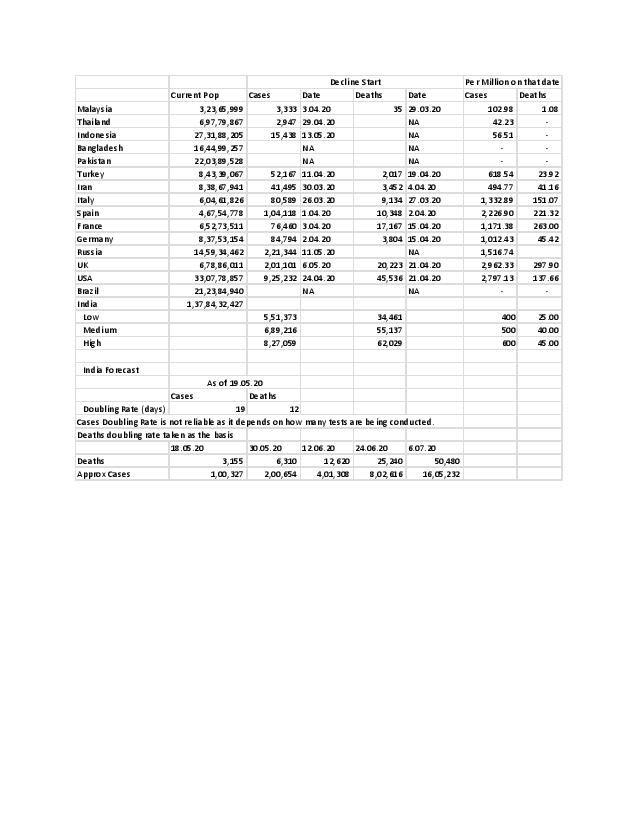
  1. Here is where I stick my neck out. I have done an international per capita model of cases and deaths and used it to forecast what will happen in India
  2. Broadly there are 3 types of countries and progression of Covid 19. Asia including Turkey and Iran where the disease progressed more rapidly and counties like Malaysia and Thailand which have hardly been touched at all.
  3. Europe and North America which are broadly similar
  4. Brazil is still to stabilize
  5. I have taken the dates on which a decline started of cases and deaths for each country and worked out the per capita cases and deaths on that day
  6. This analysis results in the conclusion that India is likely to behave like West Asia -  tropical counties of Malaysia, Indonesia and Thailand will do better than India.
  7. Deaths are more reliable than cases as a measure for forecasting as cases are dependent on how much testing is going on
  8. Based on the above analysis, my prediction is that India deaths/day will start declining around 1 July to 10 July. The number of deaths in India (based on a 7 day moving average are doubling in 12 days) will reach the projected number of 35,000 - 62,000  after which they should start declining as per the model.
  9. The decline will start earlier in places like Ahmedabad, Pune and Mumbai where the spread is already greater. However, as a whole the country will start seeing the decline on the dates stated above.
  10. This model assumes that the per capita infections and deaths when they reach a certain level in the population the infection progress recedes. It must be something similar to herd immunity but the pundits are reluctant to use that word
  11. The more you ease off from the lockdown, the quicker we will reach the tipping point. The doubling rate will become quicker.
It would be great to hear your reactions on this post.

Regards and stay safe.